
Land Rover Discovery: Tool kit
5 seat vehicles
Lift the loadspace floor to access the temporary use spare wheel and tool kit.
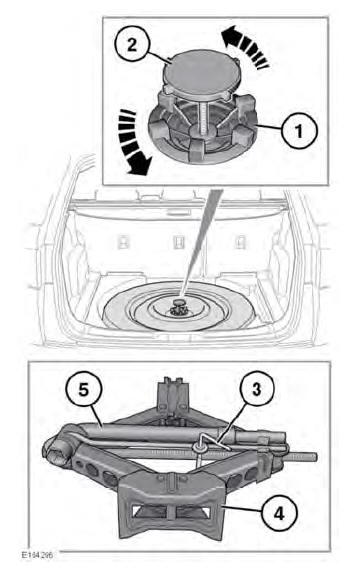
- Temporary use spare wheel locking ring.
- Temporary use spare wheel retaining bolt.
- Tool kit retaining bolt.
- Jack.
- Wheel brace.
Secure the spare wheel, or the removed wheel, in the correct position using the retaining bolt.
7 seat vehicles
Lift the loadspace floor to access the tool kit.
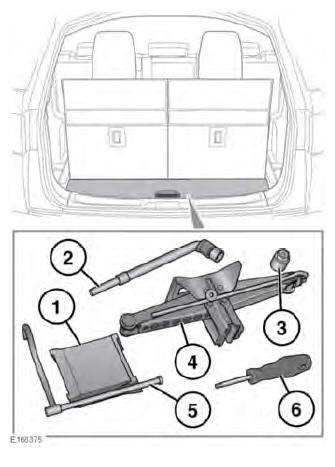
- Wheel chocks.
- Wheel brace.
- Locking wheel nut adaptor.
- Jack.
- Winch handle for lowering the temporary use spare wheel.
- Rear bumper cover removal tool.
Note: Examine the jack occasionally, clean and grease the moving parts, particularly the screw thread, to prevent corrosion.


READ NEXT:
 Removing the spare wheel
Remove the temporary spare
wheel prior to jacking the vehicle,
to avoid destabilising the vehicle
when raised.
Wheels are heavy and if handled
incorrectly may cause injury. Use
extreme caution
Using wheel chocks
Note: Not all vehicles have wheel chocks
supplied as part of the tool kit.
Wheel chocks are a useful addition to a
vehicle's tool kit. Note the following
advice when using wheel chocks:
Before raisi
Wheel changing
Before raising the vehicle, refer
to all warnings at the beginning
of this section of the Owner's
Handbook.
Before changing a wheel, read and
observe the warnings
If your vehicle is fitted with side
s
SEE MORE:
Uni-body, Subframe and Mounting
System Front
Subframe (G2028440)
- Removal
SPECIAL TOOL(S)
GENERAL EQUIPMENT
PART(S)
STEP REPLACE PART / RENEW PART PART NAME
Removal
CAUTION:
The final tightening of the suspension components must be carried
out with the vehicle on its wheels.
NOTES:
This procedure contains some variation in the illustrations
depending on the vehic
Legal Compliance
Some sites may have a discharge consent for effluent discharge to the foul
drain for a car wash etc. It is essential to know the types of effluent which
are allowed to be discharged into the drain and to check the results of any
monitoring carried out by the Water Company.
Where paint spraying oper
© 2019-2026 Copyright www.lrdisc.com
