
Land Rover Discovery: Rear end Sheet Metal Repairs Rear Floor Side Extension (G1770934) - Installation
Land Rover Discovery (2009–2016) Service Manual / Body / Body Repairs and General
Information / Rear end Sheet Metal
Repairs Rear
Floor Side
Extension (G1770934) / Rear end Sheet Metal
Repairs Rear
Floor Side
Extension (G1770934)
- Installation
Installation
- Dress the flanges where necessary.
- Offer up the new rear floor side extension and clamp into position.
Check alignment if correct, proceed to next step, if not, rectify and recheck before proceeding.
NOTE:
Make sure the holes are drilled through the side member and the rear floor side extension.
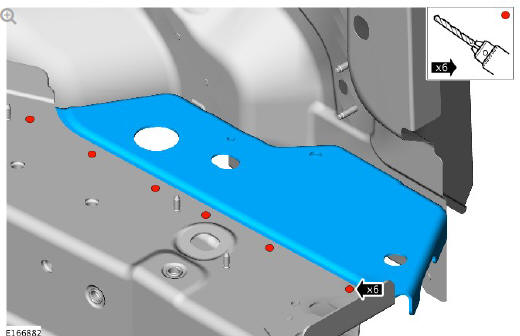
- Drill holes where the metal inert gas (MIG) plug welds are to be installed as indicated.
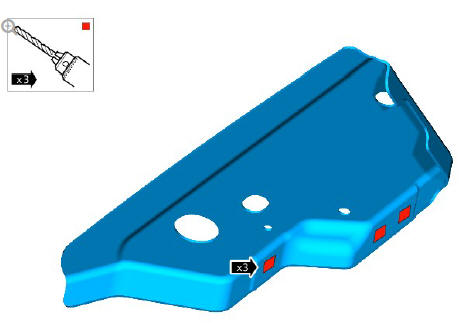
- Drill holes where the MIG plug welds are to be installed as indicated.
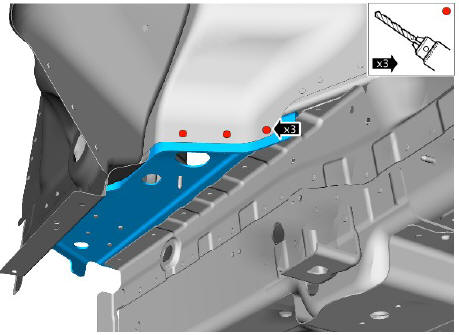
- Drill holes where the MIG plug welds are to be installed as indicated.
- Deburr the drilled holes.
- Clean and prepare the panel surfaces.
- Offer up the new rear floor side extension and clamp into position.
Check alignment if correct, proceed to next step, if not, rectify and recheck before proceeding
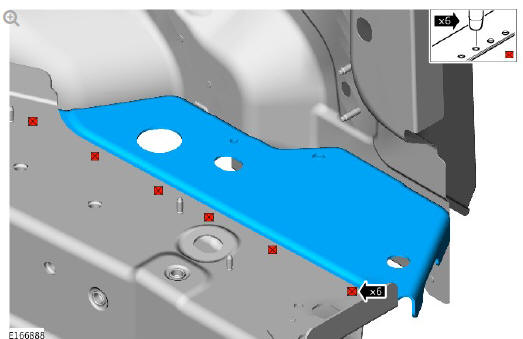
- Install the MIG plug welds as indicated.
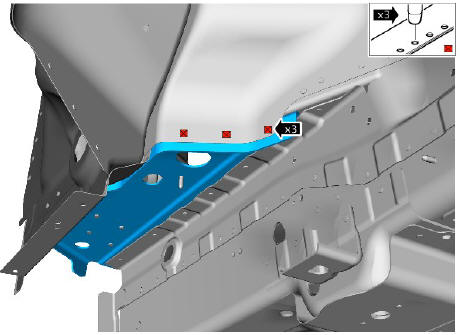
- Install the MIG plug welds as indicated.
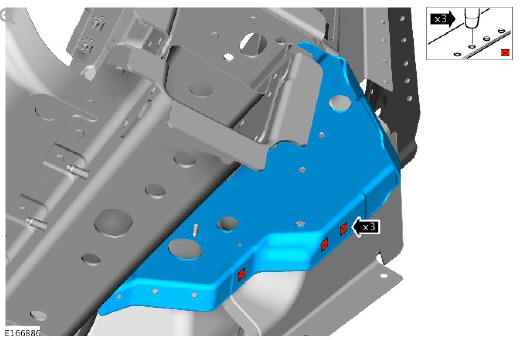
- Install the MIG plug welds as indicated.
NOTE:
The components that are located/installed to these weld studs must be offered up and cross checked for alignment prior to the installation of the weld studs to the new panel.
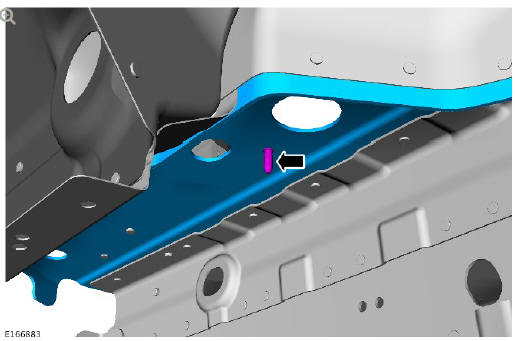
- Prepare the new panel and install the weld studs in their original locations as indicated.
- Make sure that any open or exposed panel joints are correctly sealed.
- Make sure corrosion protection is applied to all areas affected by repair.
- The installation of associated panels and components is the reversal of removal procedure.
 Rear end Sheet Metal
Repairs Rear
Floor Side
Extension (G1770934)
- RemovalRear end Sheet Metal
Repairs Rear
Bumper Retaining
Rail (G1770947) / Removal
and Installation
READ NEXT:
 Rear end Sheet Metal
Repairs Rear
Bumper Retaining
Rail (G1770947) / Removal
and Installation
REMOVAL
NOTE:
The rear bumper retaining rail is installed in conjunction with:
Rear bumper cover
Rear bumper
The rear bumper retaining rail is serviced as indicated.
Before commencing this pr
Rear end Sheet Metal
Repairs Rear
Bumper Mounting
Upper (G1780738) / Removal
and Installation
REMOVAL
NOTE:
The rear bumper mounting upper is installed in conjunction with:
Rear bumper cover
Rear bumper
Rear lamp assembly
Rear lamp panel outer
Back panel outer
The rear bumper mounti
Rear end Sheet Metal
Repairs Rear
Bumper Mounting
Lower (G1780739) / Removal
and Installation
REMOVAL
NOTE:
The rear bumper mounting lower is installed in conjunction with:
Rear bumper cover
Rear bumper
Rear lamp assembly
Rear lamp panel outer
Back panel outer
The rear bumper mounti
SEE MORE:
Hydraulic Brake Actuation Brake Fluid Reservoir (G1785123) / Removal and
Installation
REMOVAL
CAUTION:
If brake fluid is spilt on the paintwork, the affected area must be
immediately washed down with cold water.
NOTE:
Removal steps in this procedure may contain installation details.
All vehicles
Refer to: Plenum Chamber (412-01 Climate Control, Removal and Installation).
Left-hand
Touch Screen(ts) and Navigation Diagnostics
Fault codes and diagnostics can be retrieved/achieved using the
manufacturer approved diagnostic system
Hard Key Test
The hard key test is used to check the operation of the hard switches.
If switch operation is normal, the switch colour on the screen will change
when a hard switch is pressed. (Pow
© 2019-2026 Copyright www.lrdisc.com
